Wirtinger Gradients with Python
Adapting Scipy’s minimize function to operate on Wirtinger gradients in the context of phase retrieval
Efficient optimization techniques are constructed by taking gradients and Hessians of cost functions to determine direction of descent or in trust-region techniques for selecting minima of locally valid models. Optimization is typically used with cost functions over real vector variables, but this is not mandatory.
\[\min_x f(x), x\in \mathbb{C}^N\]Cost functions over complex variables do however have a slight complication that needs to be accounted for if we want to select a complex vector that minimizes a cost function. A complex variable has two degrees of freedom per entry in \(x\), and both of these need to be accounted for. While we are traditionally used to accounting for this with a real and imaginary component, Wirtinger calculus allows us to perform calculus directly on a complex variable and its conjugate. Note I follow the standard notation of \(z\) and \(z^*\) for a complex variable and its conjugate.
This feature is particularly useful because many cost functions over complex variables are naturally written as a function of complex variables and their conjugate. To steal an example from Adali et al [1] (a fantastic source on multiple topics in complex valued math for signal processing), we examine the cost function \(f(z) = |z|^4\). This function can obviously be written as the sum of a real and a complex variable \(z = z_r + jz_i\) whose terms can be expanded like so:
\[\begin{aligned} f(z) &= |z|^4 \\ &= (z_r+ jz_i)^2 (z_r - jz_i)^2 \\ &= z_r^4 + 2 z_r^2 z_i^2 + z_i^4 \\ \end{aligned}\]Differentiating with respect to \(z_r\) and \(z_i\) we get the following two expressions. Note we regroup back into terms of \(z\) and \(z^*\).
\[\begin{aligned} \frac{\partial f}{\partial z_r} &= 4z_r^3 = 4z_i^2 z_r\\ &= 4z_r(z_r^2 + z_i^2) \\ &= 4z_r(z_r + j z_i)(z_r - j z_i) \\ &= 4z_r zz^* \\ \frac{\partial f}{\partial z_i} &= 4z_i^3 = 4z_r^2 z_i\\ &= 4z_i(z_r^2 + z_i^2) \\ &= 4z_i(z_r + j z_i)(z_r - j z_i) \\ &= 4z_i zz^* \\ \end{aligned}\]To see why these answers are significant, we turn to a slightly simpler operation; differentiation of our example cost function with respect to the variable \(z\) and \(z^*\) while the other is held constant:
\[\begin{aligned} \frac{\partial f}{ \partial z} &= 2z z^* z^* \\ \frac{\partial f}{ \partial z^* } &= 2z z z^* \\ \end{aligned}\]We see that from this expression that we can actually write these two resulting pairs as linear combinations of the other:
\[\begin{align} \frac{\partial f}{\partial z} &= \frac{1}{2}\left( \frac{\partial f}{\partial z_r} -j \frac{\partial f}{\partial z_i}\right) \\ \frac{\partial f}{\partial z^* } &= \frac{1}{2}\left( \frac{\partial f}{\partial z_r} +j \frac{\partial f}{\partial z_i}\right) \end{align}\]What this means for us is that we get to work with a simpler set of variables while differentiating complex cost functions while remaining functionally equivalent to differentating with respect to real and imaginary parts. In Wirtinger calculus, we differentiate a complex function \(f(z, z^* )\) with respect to both \(z\) and \(z^*\) holding the other constant. All the old rules of purely real calculus hold including chain rule and product rule. All your favorite functions will obey familiar differentiation rules. I like this fairly comprehensive tutorial: [2].
For use in optimization however, the cost function will be real; we like to be able to order a cost function and say that one point is better or “lower” than another and this is poorly defined for complex numbers. In this case, the derivative of the cost function with respect to \(z\) and \(z^*\) will merely be conjugates of each other. To perform optimization however, we would like to take our result of differentation and generalize it to the notion of a gradient, called throughout the Wirtinger gradient. I was first introduced to this topic through papers on Wirtinger Flow in the problem of phase retrieval, which is the example I will give in Scipy here today. The original paper on Wirtinger descent applied to phase retrieval, as well as a personal favorite on studying it geometrically can be found here respectively: [3] [4].
To form the gradient, we sequentially take the Wirtinger derivative of a cost function with respect to each of its $N$ complex variables to form a complex row vector [4]. Note we will denote this as differentiating with respect to a complex vector, which we will signify with bold font like this: \(\mathbf{z}\). Concatenating the row vector derivatives against the variables \(\mathbf{z}, \mathbf{z}*\), we arrive at the Wirtinger gradient \(\nabla f\) by taking the complex tranpose:
\[\begin{align} \frac{\partial f}{\partial \mathbf{z}} &= \left( \frac{\partial f}{\partial z_0}, \dots, \frac{\partial f}{\partial z_{N-1}} \right) \\ \frac{\partial f}{\partial \mathbf{z}^* } &= \left( \frac{\partial f}{\partial z_0^* }, \dots, \frac{\partial f}{\partial z_{N-1}^* } \right) \\ \nabla f &= \left( \frac{\partial f}{\partial \mathbf{z}}, \frac{\partial f}{\partial \mathbf{z}^* } \right)^H \end{align}\]We use \(f\) alone as a short-hand but understand that the function is dependent on both \(\mathbf{z}\) and \(\mathbf{z}^*\).
We summarize the relationship between the Wirtinger gradient and the gradient with respect to real and imaginary componenets individually (\(\nabla_R f\)) with the matrix \(T_N\) defined bellow [1]:
\[\begin{align} T_N &= \begin{pmatrix} \mathbb{I}_N & j \mathbb{I}_N \\ \mathbb{I}_N & -j \mathbb{I}_N \end{pmatrix} \\ \nabla f &= T_N \nabla_R f \end{align}\]where \(I_N\) is the identity matrix of dimension \(N\times N\). We note that the Wirtinger Hessian can also be defined in a simililar manner [4]:
\[\begin{align} \nabla^2 f &= \begin{pmatrix} \frac{\partial}{\partial \mathbf{z}}\left(\frac{\partial f}{\partial \mathbf{z}}\right)^H && \frac{\partial}{\partial \mathbf{z}^*}\left(\frac{\partial f}{\partial \mathbf{z}}\right)^H \\ \frac{\partial}{\partial \mathbf{z}}\left(\frac{\partial f}{\partial \mathbf{z}^*}\right)^H && \frac{\partial}{\partial \mathbf{z}^*}\left(\frac{\partial f}{\partial \mathbf{z}^*}\right)^H \\ \end{pmatrix} \end{align}\]The Hessian with respect to the real and imaginary parts of \(f\) are realated to the Wirtinger Hessian through the following tranform:
\[\begin{align} \nabla^2 f &= T_N \nabla_R^2 f T_N^H \end{align}\]To go back and forth between the two representations we’ll need an inverse for \(T_N\):
\[\begin{align} T_N^{-1} &= \frac{1}{2}T_N^H \end{align}\]Phase Retrieval
Phase retrieval is an awesomely simple “devil in the details” non-convex optimization problem that have had some very powerful approaches applied to it. For an introduction to the problem and an overview of recent and historical solutions, I recommend perusing [5] or [6]. We’re going to use the intensity based definition similar to the one in [3]:
\[\begin{align} \text{find } & \mathbf{z}\\ \text{such that }& y_i = |\mathbf{a}_i^H \mathbf{z}|^2 \\ i &\in \left[ 0,1,2,..., M-1 \right] \end{align}\]Here, the measurements \(y_i\) are intensity measurements of the inner product between a known vector \(\mathbf{a}_i \in \mathbb{C}^N\) and the unknown vector we’d like to recover \(\mathbf{z} \in \mathbb{C}^N\). We note that there can often be strictly non-negative noise added to each variable \(y_i\). Often times a least-squares approach is taken to minimize the error between measurements and their reconstruction [3], [4]. We’ll go ahead and form the cost function for this least squares approach here:
\[\begin{align} \min_\mathbf{z} f(\mathbf{z}, \mathbf{z}^*) &= \min_\mathbf{z} \frac{1}{2 M}\sum_{i=0}^{M-1} \left( y_i - |\mathbf{a}_i^H \mathbf{z} |^2\right)^2 \\ & \downarrow \\ \min_\mathbf{z} f(\mathbf{z}, \mathbf{z}^*) &= \min_\mathbf{z} \frac{1}{2 M}\sum_{i=0}^{M-1} \left( y_i - \mathbf{z}^H\mathbf{a}_i \mathbf{a}_i^H \mathbf{z} \right)^2 \end{align}\]This description is suggestive of course because this entire formulation can be written in terms of a complex vector and its gradient. Finally, we a function we can apply complex gradient and Hessian to. We will do one final augmentation of our cost function \(f(\mathbf{z}, \mathbf{z}^*)\) to make it a little easier to adapt to code by vectorizing it. We will use the shorthand \(\mathbf{y}\) to represent the formation of a vector from the measurements \(y_i, i\in [0,1,2,...,M-1]\). The matrix \(A\) is similarly formed with \(a_i\) as its collumns. We will abuse \(\odot\) for element-wise products (or an element multiplying a whole row for a product between a vector and matrix), and the square in the following (being internal to the sum) is element-wise as well. Sum over index is assumed:
\[\begin{align} f(\mathbf{z}, \mathbf{z}^*) & = \frac{1}{2 M} \sum \left( (z^H A)\odot(A^H z) - y \right)^2 \end{align}\]Applying the Wirtinger gradient we arrive at results equivalent to those in [4]:
\[\begin{align} \frac{\partial f}{\partial \mathbf{z}} &= \frac{1}{M} A (\mathbf{r} \odot \mathbf{g}) \\ \mathbf{g} &= A^H z \\ \mathbf{r} &= (z^H A)\odot(A^H z) - y \\ \nabla f &= \left( \frac{\partial f}{\partial \mathbf{z}}, \left( \frac{\partial f}{\partial \mathbf{z} } \right)^* \right)^H \end{align}\]Similarly, we arrive parts for the Wirtinger Hessian:
\[\begin{align} \frac{\partial}{\partial \mathbf{z}}\left(\frac{\partial f}{\partial \mathbf{z}}\right)^H &= \frac{1}{M} A (\mathbf{r}_+ \odot A^H) \\ \frac{\partial}{\partial \mathbf{z}^*}\left(\frac{\partial f}{\partial \mathbf{z}}\right)^H &= \frac{1}{M} A (\mathbf{g}^2 \odot A^T) \\ \mathbf{g} &= A^H z \\ \mathbf{r}_+ &= 2 (z^H A)\odot(A^H z) - y \\ \end{align}\]where the full Hessian is constructed as:
\[\begin{align} nw &=\frac{\partial}{\partial \mathbf{z}}\left(\frac{\partial f}{\partial \mathbf{z}}\right)^H \\ ne &= \frac{\partial}{\partial \mathbf{z}^*}\left(\frac{\partial f}{\partial \mathbf{z}}\right)^H \\ \nabla^2 f &= \begin{pmatrix} nw & ne \\ ne^* & nw^* \end{pmatrix} \end{align}\]Python
Now the fun part, we’re going to adapt all this into Python to use the powerful minimize function that comes with Scipy. Scipy optimizes over a real variable, so we will develop our Wirtinger gradient and Hessian over a complex variable that is wrapped in a real conversion function that minimize will call.
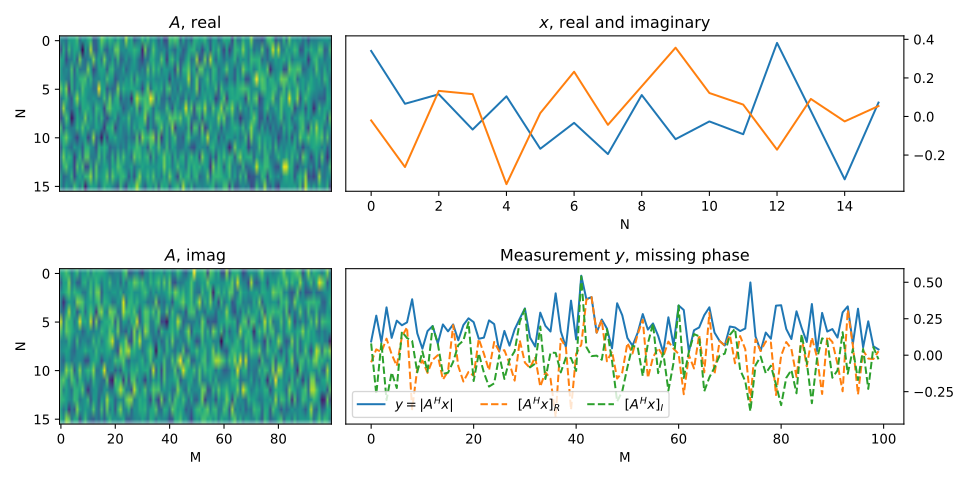
We begin by creating functions to generate test vectors for recovery and test matrices to generate phaseless measurements. For both of these we will be using complex Gaussian distributed random numbers to demonstrate arbitrary varibles. We generate a test function to create an arbitrary \(\mathbf{x}\), an arbitrary \(A\), and their resulting phaseless measurements \(\mathbf{y} = |A^H \mathbf{x}|\).
1
2
3
4
5
6
7
8
9
10
11
12
13
14
15
16
17
18
19
20
21
22
23
24
25
26
27
28
29
30
31
32
33
34
35
36
37
38
39
40
41
42
43
44
45
46
47
48
49
50
51
52
53
54
import numpy as np
import matplotlib.pyplot as plt
from scipy.optimize import minimize
import matplotlib.gridspec as gridspec

def cgaus(rows,cols):
    val = np.random.randn(rows,cols) +\
          np.random.randn(rows,cols) * 1j
    val /= np.linalg.norm(val,axis=0)[None,:]
    return val

def meas(X,A):
    y = np.abs(A.conj().T @ X)
    return y

def test_meas():
    N = 16
    m = 100
    X = cgaus(N,1)
    A = cgaus(N,m)
    y = meas(X,A)
    plot_setup(X,A,y)

def plot_setup(X,A,y):
    fig = plt.figure(figsize=[10,5])
    gs = gridspec.GridSpec(2,3,figure=fig)
    ax1 = fig.add_subplot(gs[0,0])
    ax2 = fig.add_subplot(gs[1,0])
    ax3= fig.add_subplot(gs[0,1:])
    ax4 = fig.add_subplot(gs[1,1:])
    ax1.imshow(np.real(A),aspect = 'auto',interpolation='none')
    ax2.imshow(np.imag(A),aspect = 'auto',interpolation='none')
    ax1.xaxis.set_visible(False)
    ax1.set_ylabel("N")
    ax2.set_ylabel("N")
    ax2.set_xlabel("M")
    ax3.plot(np.real(X),label='real')
    ax3.plot(np.imag(X),label='imag')
    ax3.set_xlabel("N")
    ax4.plot(y,label='$y=|A^Hx|$')
    ax4.plot(np.real(A.conj().T @ X).flatten(),label='$[ A^H x ]_R$',linestyle='--')
    ax4.plot(np.imag(A.conj().T @ X).flatten(),label='$[ A^H x ]_I$',linestyle='--')
    ax4.set_xlabel("M")
    ax4.legend(ncol=3,loc='lower left')
    ax3.yaxis.tick_right()
    ax3.yaxis.set_label_position('right')
    ax4.yaxis.tick_right()
    ax4.yaxis.set_label_position('right')
    ax1.set_title("$A$, real")
    ax2.set_title("$A$, imag")
    ax3.set_title("$x$, real and imaginary")
    ax4.set_title("Measurement $y$, missing phase")
    fig.tight_layout()
    plt.show()
An example of a plot created by this code is here:
Next up, we need functions to create cost function, the Wirtinger gradient and Hessian functions, and functions to wrap them so we can call them from Scipy minimize. We will pass a concatenated vector (real/imag) from Scipy, so this wrapping function will do the conversion to complex variables and their conjugate. The wrapping functions are prepended with “scipy”. We also demonstrate that the values are identical in a test function when transformed by the \(T_N\) matrices defined earlier.
1
2
3
4
5
6
7
8
9
10
11
12
13
14
15
16
17
18
19
20
21
22
23
24
25
26
27
28
29
30
31
32
33
34
35
36
37
38
39
40
41
42
43
44
45
46
47
48
49
50
51
52
53
54
55
56
57
58
59
60
61
62
63
64
65
66
67
def wgrad(x,y,A):
    # Wirtinger gradient of the standard PR cost function
    forward = A.conj().T@x
    resid =  np.abs(forward)**2 - y**2
    prod = (A @ (resid * forward)) / A.shape[1]
    return np.vstack([prod,prod.conj()])

def whess(x,y,A):
    # Wirtinger Hessian of the standard PR cost function
    forward = A.conj().T@x
    resid_plus =  2 * np.abs(forward)**2 - y**2
    nw = A @ (resid_plus*A.conj().T)
    ne = A @ (forward ** 2 * A.T)
    top = np.hstack([nw,ne])
    bottom = np.hstack([ne,nw]).conj()
    return np.vstack([top,bottom]) / A.shape[1]

def scipy_wgrad(x,y,A):
    N = x.shape[0]//2
    X = x[:N] + 1j * x[N:]
    X = X.reshape(N,-1)
    grad = wgrad(X,y,A)
    z = grad[:N]
    zc = grad[N:]
    return np.real(np.vstack([z + zc,1j * (zc - z)])).flatten()/2

def scipy_whess(x,y,A):
    N = x.shape[0]//2
    X = x[:N] + 1j * x[N:]
    X = X.reshape(N,-1)
    hess = whess(X,y,A)
    a,b,c,d = hess[:N,:N],hess[:N,N:],hess[N:,:N],hess[N:,N:]
    H = np.zeros_like(hess)
    H[:N,:N] =  a + b + c + d
    H[:N,N:] =(-a + b - c + d) * -1j
    H[N:,:N] =( a + b - c - d) * -1j
    H[N:,N:] =  a - b - c + d
    return np.real(H) / 4

def test_wirt():
    N = 16
    m = 100
    X = cgaus(N,1)
    A = cgaus(N,m)
    y = meas(X,A)
    pert = X + cgaus(N,1) * 1e-0

    grad = wgrad(pert,y,A)
    hess = whess(pert,y,A)

    ripert = np.vstack([np.real(pert),np.imag(pert)]).flatten()
    sgrad = scipy_wgrad(ripert,y,A)
    shess = scipy_whess(ripert,y,A)

    Tx = np.vstack([np.hstack([np.eye(N), 1j * np.eye(N)]),\
                    np.hstack([np.eye(N),-1j*np.eye(N)])])

    grad_cx = (Tx @ sgrad).flatten()
    grad = grad.flatten()
    grad_ri = (Tx.T.conj() @ grad).flatten()/2
    print(np.linalg.norm( grad - grad_cx))
    print(np.linalg.norm( grad_ri - sgrad.flatten()))

    hess_cx = Tx @ shess @ Tx.T.conj()
    hess_ri = Tx.T.conj() @ hess @ Tx  / 4
    print(np.linalg.norm(hess - hess_cx))
    print(np.linalg.norm(shess - hess_ri))
These evaluate to machine precision. One final detail is that any optimization that recovers \(x\) will be off by a global phase, so we have a utility function for recovered vectors that aligns phase to ground-truth for the purpose comparison. This is a cheap trick to determine phase difference between the recovered vectors, we demix one vector with another, and take the median phase offset.
1
2
3
4
def align(xout,X):
    phasing = np.median(np.angle(xout.conj() * X.flatten()))
    xout *= np.exp(1j * phasing)
    return xout
This final test function puts everything together: creating a test set, adding noise at controlled SNR, initialize a starting point for optimization randomly, calls minimize with “Newton-CG” options, and then plots results. I encourage testing with various methods, a favorite of mine is Newton-CG and L-BFGS-B. Both converge (as my old mentor Scott would say) “like a bat out of hell”.
1
2
3
4
5
6
7
8
9
10
11
12
13
14
15
16
17
18
19
20
21
22
23
24
25
26
27
28
29
30
31
32
33
34
35
36
37
38
39
40
41
42
43
44
45
46
47
48
49
50
51
52
53
54
55
56
57
58
59
60
def test_grad_descent():
    N = 32
    m = N * 10
    X = cgaus(N,1)
    A = cgaus(N,m)
    y = meas(X,A)
    snr = 60
    noise = np.random.randn(m)**2
    noise/=np.linalg.norm(noise)/np.linalg.norm(y)
    y += noise[:,None] * 10**(-snr/20)
    pert = cgaus(N,1)
    print(np.linalg.norm(pert - X))

    init = np.vstack([np.real(pert), np.imag(pert)]).flatten()
    x = minimize(cost,init,args=(y,A),\
                 method='Newton-CG',jac=scipy_wgrad,\
                 hess = scipy_whess,
                 options=dict(disp=True),tol = 1e-16)
    print(x)

    xout = x.x[:N] + x.x[N:] * 1j
    xout = align(xout,X)

    plot_result(xout,X, y, A)

def plot_result(xout,X,y,A):
    error = np.linalg.norm(xout - X.flatten())
    y_rec = np.abs(A.conj().T @ xout).flatten()
    y = y.flatten()

    fig = plt.figure(figsize=[10,5])
    gs = gridspec.GridSpec(2,2,figure=fig)
    ax1 = fig.add_subplot(gs[:,:1])
    ax2 = fig.add_subplot(gs[0,1:])
    ax3 = fig.add_subplot(gs[1,1:])

    ax1.semilogy(y,label='$y$')
    ax1.semilogy(y_rec,label='$y_{rec}$')
    ax1.semilogy(np.abs(y - y_rec),label='$|y-y_{rec}|$')
    ax1.legend()

    ax2.plot(np.abs(X.flatten()),label='x')
    ax2.plot(np.abs(xout),label='x_{rec}')
    ax2.plot(np.abs(xout - X.flatten()),label='|x - x_{rec}|')
    ax2.legend()

    ax3.plot(np.angle(X.flatten() * xout.conj()))
    ax1.set_title(r"$y = |A^H x| + w[n]$ and $y_{rec} = |A^H x_{rec}|$")
    ax2.set_title(r"$|x|$ and recovered $|x_{rec}|$")
    ax3.set_title(r"$ \angle (x \odot x_{rec}^*)$")

    ax2.xaxis.set_visible(False)
    ax3.set_xlabel("N")

    ax2.yaxis.tick_right()
    ax2.yaxis.set_label_position('right')
    ax3.yaxis.tick_right()
    ax3.yaxis.set_label_position('right')
    ax1.set_xlabel("M")
    plt.show()
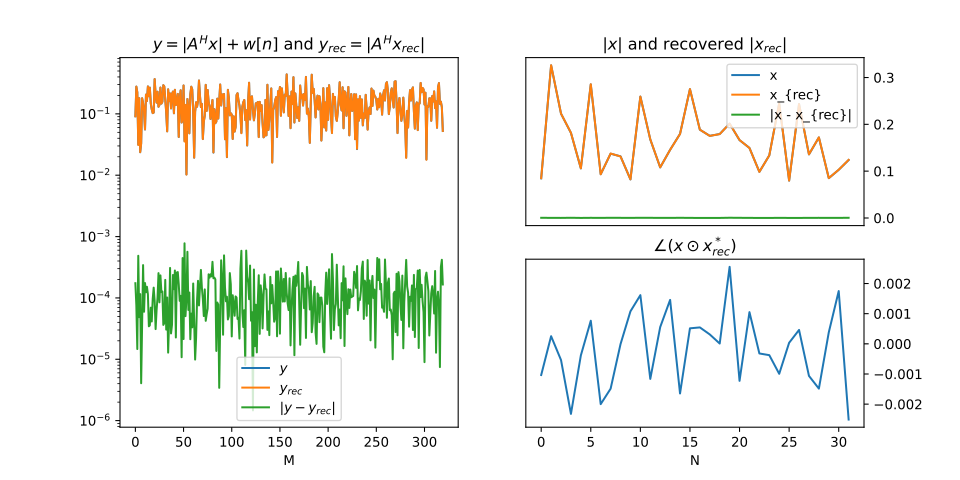
The output plot is shown here. After phase alignment, the result is quite comparable even with random initialization and noise.
The relationship between noise, measurement count, and problem dimension are explored extensively in the literature including [5]. Thank you for perusing and I hope that this demonstration helps you if you ever need to use Python for Wirtinger descent problems!
- [1]T. Adali, P. J. Schreier, and L. L. Scharf, “Complex-valued signal processing: The proper way to deal with impropriety,” IEEE Transactions on Signal Processing, vol. 59, no. 11, pp. 5101–5125, 2011.
- [2]K. Koor, Y. Qiu, L. C. Kwek, and P. Rebentrost, “A short tutorial on Wirtinger Calculus with applications in quantum information,” 2023, Available at: https://arxiv.org/abs/2312.04858
- [3]E. J. Candès, X. Li, and M. Soltanolkotabi, “Phase Retrieval via Wirtinger Flow: Theory and Algorithms,” IEEE Transactions on Information Theory, vol. 61, no. 4, pp. 1985–2007, Apr. 2015, doi: 10.1109/tit.2015.2399924.
- [4]J. Sun, Q. Qu, and J. Wright, “A Geometric Analysis of Phase Retrieval,” Foundations of Computational Mathematics, vol. 18, no. 5, pp. 1131–1198, Aug. 2017, doi: 10.1007/s10208-017-9365-9.
- [5]K. Jaganathan, Y. C. Eldar, and B. Hassibi, “Phase Retrieval: An Overview of Recent Developments,” 2015, Available at: https://arxiv.org/abs/1510.07713
- [6]D. J. Rosen, “Structured inverse problems in ultrafast optics,” 2024.